Turn Event Interviews Into a Corporate Video Podcast
Your event already puts your best guests in one room, in good wardrobe, in a quoting mood. Here's how one filming day seeds months of a video interview series.
Your event already puts your best guests in one room, in good wardrobe, in a quoting mood. Here's how one filming day seeds months of a video interview series.
Almost every company I talk to wants a podcast.
They've read that buyers love them. They've watched a competitor build a following with a video interview show. So they decide to start one. They buy a couple of microphones, block a recording day, and then the whole thing stalls in the same place every time: nobody can get the guests on the calendar.
That's the part nobody warns you about. The mics are easy. The editing is solvable. Booking a busy executive or a marquee customer for a 40-minute conversation, three weeks out, by Zoom, is where corporate podcasts go to die.
Here's the thing. You already solve that problem once a year, and you don't even realize it.
It's your event.
Because the guests are already there. The single biggest reason corporate podcasts stall is guest scheduling, and an event concentrates your executives, marquee customers, and partners in one building on one day. With 54% of US adults having listened to a podcast in the past year (Pew Research Center, 2025), the audience is ready. You just need the conversations.
Think about who's in the room at your annual conference or customer summit. Your CEO. Two or three product leaders. A handful of your best customers who flew in to speak on a panel. The partner whose logo you've been trying to feature for a year. Outside the event, getting any one of them on a recording is a month of calendar tennis.
Inside the event, they're standing thirty feet away, already mic-checked, already in good wardrobe, and already in a talking mood. That last part matters more than people think. Event energy makes people generous with quotes.
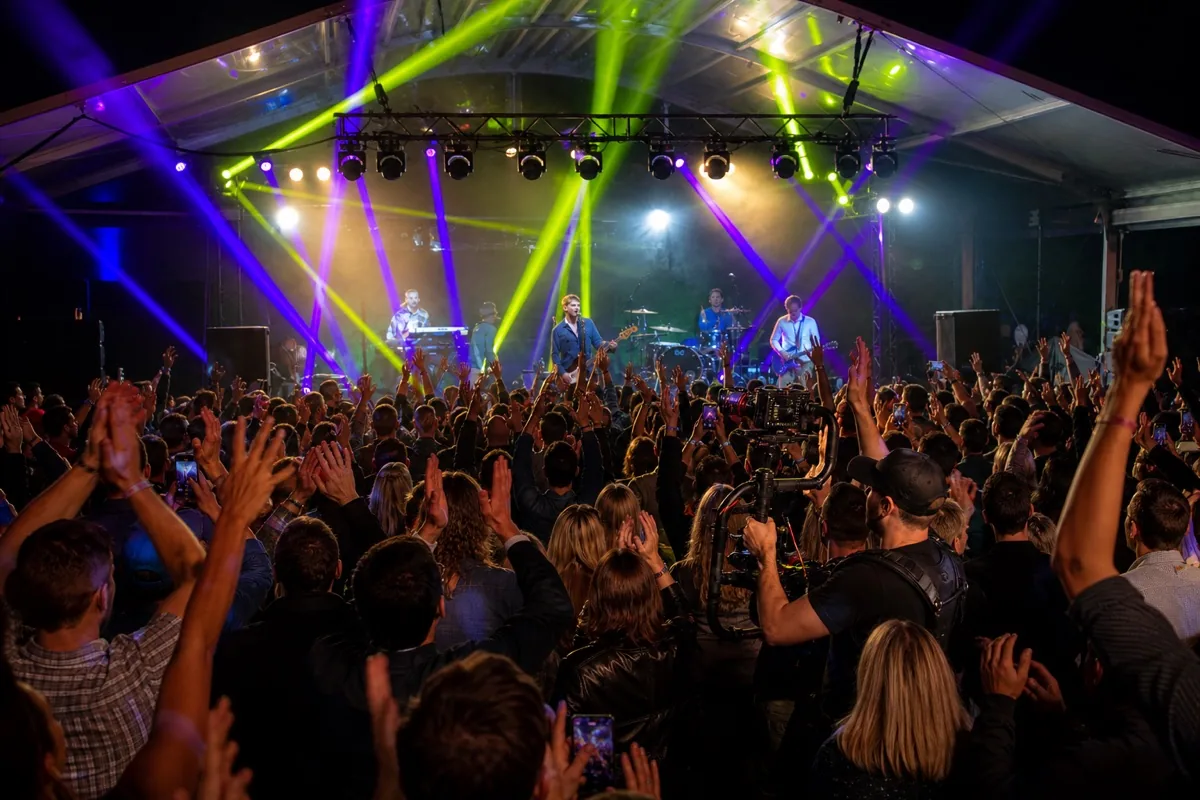
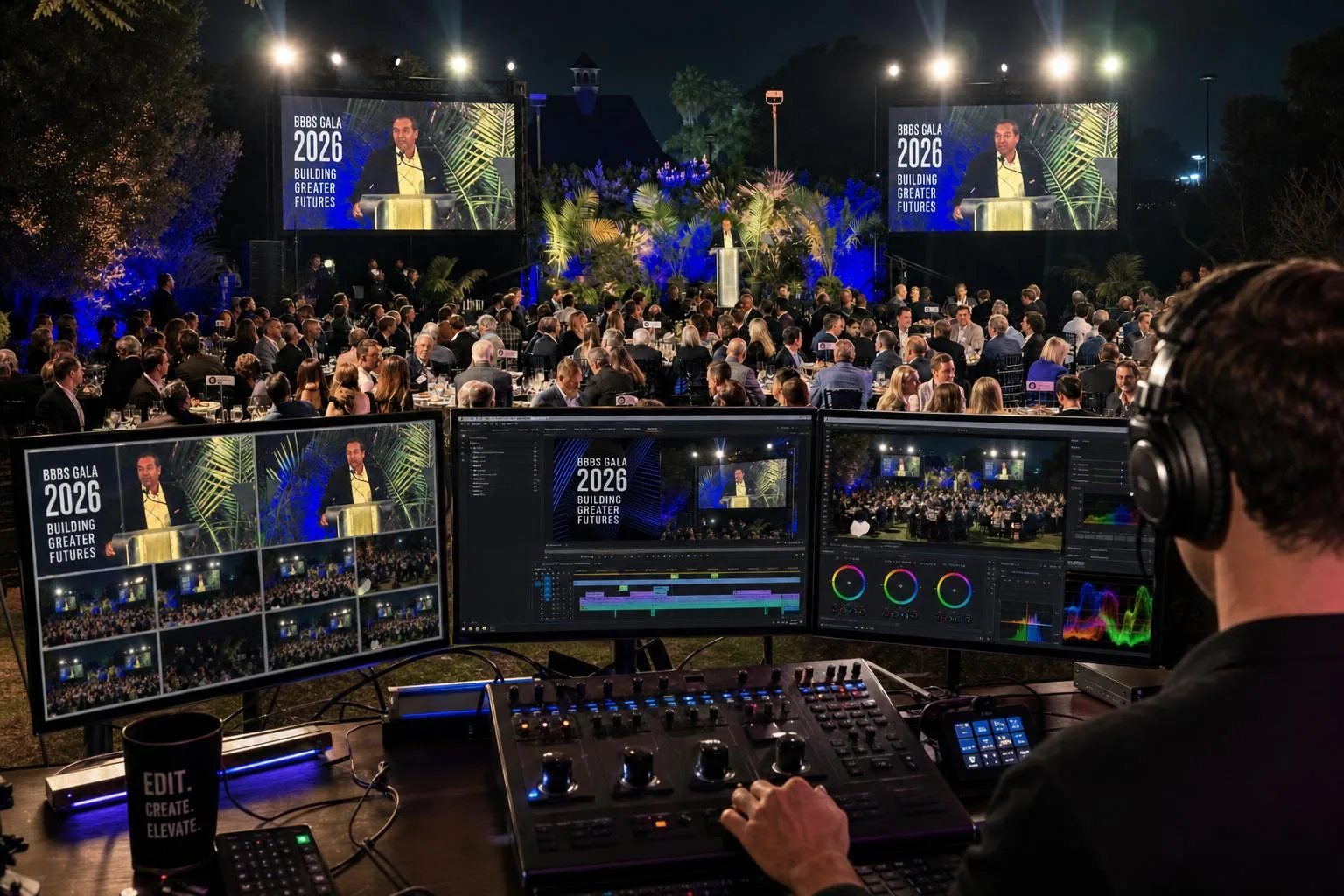
So here's the move. We set up one controlled-audio corner, away from the main room noise, with proper lighting and a clean two-camera setup. Then we run guests through it in scheduled 20 to 30 minute slots across the day. One crew. One corner. Six to ten interviews before load-out.
That's not a souvenir clip. That's a season.
The guests a podcast spends three months chasing are already in your building, mic-checked and in a quoting mood. The event books them for you.
Capture video. Edison Research found that 51% of the US 12+ population has watched a video podcast, and 48% have both listened to and watched one (Edison Research, The Podcast Consumer 2025). When you film the interview, you can ship one conversation as a long-form video, as social clips, and as an audio episode. Video is the superset. Audio-only throws away every visual format before you start.
Look at the recency curve, because it tells you where the format is heading. More than half the country has tried a video podcast, and more than a third watched one in just the last month.
Here's why this changes the math for an event. If you only record audio, you have one deliverable. If you film it, the same 25-minute conversation renders as a YouTube long-form episode, four or five LinkedIn-native vertical clips, quote graphics, and the audio cut for Spotify and Apple. One capture, every format.
That's the part "video podcast" undersells. It isn't a show. It's a format-agnostic content engine. Our content creation team builds the edit plan around all of those outputs before the first guest sits down, so nothing useful gets left on the timeline.
Mostly YouTube, then everywhere else. Edison Research's Infinite Dial 2025 found YouTube is the single most-used service for podcasts in the US, used by 33% of weekly podcast listeners, ahead of both Spotify and Apple (Edison Research, The Infinite Dial 2025). So your full episodes live on YouTube as searchable, evergreen video while clips do the reach work elsewhere.
This is the practical reason to capture video, not just audio. YouTube isn't really a video site to your buyer anymore. It's where a lot of people listen to podcasts in the background. Filming the interview means you show up in the one place the most people already go for the format, instead of betting everything on audio apps.
From there, the distribution looks like a fan-out. The long-form episode anchors your YouTube channel and your resource pages. The vertical clips run on LinkedIn, where your B2B buyers actually scroll. The audio version reaches the commuter and the gym crowd on Spotify and Apple. Same interview, four front doors.
In my experience, the companies that win here don't pick a platform. They cut one conversation for all of them and let each person find it in the mode they prefer. That's only possible if you captured video on the day.
We'll set up the controlled-audio corner, run your guests through scheduled slots, and hand you a season of episodes, clips, and audio cuts. One crew, one day.
See How We Build Interview Series →They do, and they use them to learn. Pew Research Center found 54% of US adults listened to a podcast in the past 12 months, and 32% get news or information from podcasts at least sometimes (Pew Research Center, 2025). That information-seeking intent is exactly the behavior a thought-leadership interview series is built to serve.
This is the objection I hear most from B2B teams. "Podcasts are for hobbyists and true-crime fans, not for people buying enterprise software." The data says otherwise. A third of US adults are actively turning to podcasts to get news and information, and that's the same mindset that makes someone watch a 25-minute interview with your VP of product about where the category is going.
Your buyers are already using the format to learn things. The question is whether the thing they learn comes from you or from a competitor. A video interview series puts your leaders and your happiest customers in front of that intent, instead of asking a busy buyer to read one more whitepaper.
And the guests you'd put on that show, the experts and the reference customers, are sitting in your event right now.
Still growing, sharply. Edison Research found total weekly time spent with podcasts in the US is up 355% since 2015, reaching 773 million hours per week (Edison Research, The Podcast Consumer 2025). A series you launch now rides a rising trend, not a peaking one. Building a back catalog today compounds as the audience keeps expanding around it.
That 355% number deserves a second read. We're not talking about a small format clawing for relevance. Weekly time spent has more than quadrupled in a decade, and the video side of it, the part you can only serve if you filmed the interview, is the fastest-growing slice.
Here's the contrarian read most agencies won't give you. You don't need to commit to a weekly podcast forever to benefit from this growth. You need a back catalog that's discoverable while the audience keeps climbing. An event-fed series gives you that catalog in concentrated bursts, which is a far more honest fit for a company than pretending you'll record a new episode every single week.
You batch them at the event. An event is a multi-guest shoot, and because 48% of Americans both watch and listen to podcasts (Edison Research, The Podcast Consumer 2025), each interview becomes a video episode, an audio episode, and several vertical clips. One filming day with 6 to 10 leaders, customers, and partners seeds months of a series.
This is the real unlock, so let me lay out how it actually runs on the day.
We pick a quiet, controllable spot away from the main room and treat it like a pop-up studio: proper lighting, a clean backdrop, and audio that comes off the board, not off a phone. The interview should look intentional, not like it was grabbed in a hallway.
Guests get booked into 20 to 30 minute windows around their speaking times, so it's a calendar invite, not a surprise. Because they're already on site, saying yes costs them almost nothing. That's the whole reason the event solves the scheduling problem.
After 28 years of producing corporate events, here's the pattern I trust: each captured conversation renders into a long-form video episode, an audio episode, and several vertical clips for social. Ten interviews can become ten episodes plus 40 or more clips, all from one day's filming.
The clips that travel are the ones posted while the event is still a conversation. We turn around a first wave of vertical cuts the same week, so the series launches with momentum instead of going quiet for a month. The long-form episodes then roll out on a cadence you control.
That's how you run a video interview series without a year-round production burden. You don't film fifty-two times a year. You film once, in concentrated bursts, where the guests already are.
Capture video. Edison Research found 51% of the US 12+ population has watched a video podcast, and 48% have both listened to and watched one. When you film the interview, you can ship it as a long-form video episode, social clips, AND an audio episode from the same recording. Video is the superset. Audio-only locks you out of every visual format from the start.
Mostly YouTube. Edison Research's Infinite Dial 2025 found YouTube is the single most-used service for podcasts in the US, used by 33% of weekly podcast listeners, ahead of both Spotify and Apple. So your full episodes live on YouTube as searchable video, short vertical cuts carry reach on LinkedIn, and the audio version reaches commuters on Spotify and Apple.
Yes. Pew Research Center found 54% of US adults listened to a podcast in the past 12 months, and 32% get news or information from podcasts at least sometimes. That information-seeking intent is exactly the behavior a thought-leadership interview series serves. Your buyers are already using the format to learn, so a video podcast meets them there.
Still growing, and fast. Edison Research found total weekly time spent with podcasts in the US is up 355% since 2015, reaching 773 million hours per week. A series you launch now rides a rising trend rather than a peaking one. Building a back catalog today compounds as the audience keeps expanding around it.
Use your event as the studio. An event is a multi-guest shoot, and because 48% of people both watch and listen to podcasts (Edison Research), each interview becomes a video episode, an audio episode, and several vertical clips. One filming day with 6 to 10 leaders, customers, and partners seeds months of a series, so you're not chasing guests every week.
You don't need a podcast studio. You need a plan for the day you already have your best guests in one room.
Your event is the one moment all year when your executives, your reference customers, and your partners are concentrated in a single building, in good wardrobe, ready to talk. That's the asset. Treat it as one. Set up a controlled-audio corner, run 6 to 10 interviews through scheduled slots, and walk out with a season instead of a single recap clip.
From there, one crew turns each conversation into a video episode, an audio episode, and a stack of social cuts, reaching the same person in whatever mode they prefer. That's a content engine, not a souvenir.
If you want help building that out, a video interview series off your next event is exactly what we do, and how it fits the wider plan is covered in our complete guide to corporate event video production. We can also handle the on-site capture end to end.
15-minute call. No pitch. Just a conversation about your event and the interview series you could walk away with.
Let's Talk →Currently accepting Spring 2026 events