Live Streaming and Video Capture With One Crew
Hiring a streaming vendor and a separate video team means paying twice for one camera signal. Here's why one crew that streams and captures wins.
Hiring a streaming vendor and a separate video team means paying twice for one camera signal. Here's why one crew that streams and captures wins.
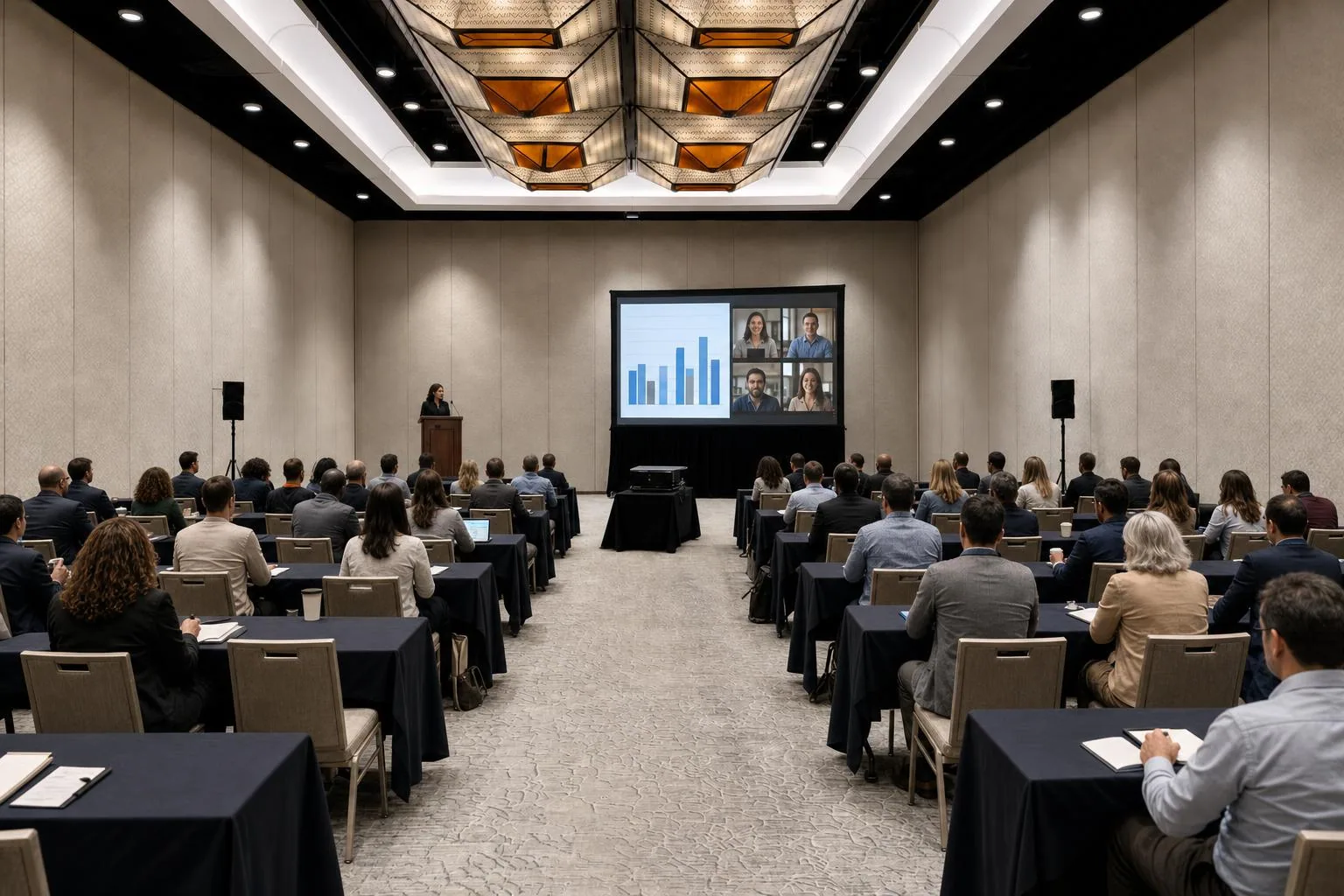
I watched it happen again last spring.
A client booked a streaming vendor to push their conference out to a remote audience. Smart. Then, separately, they booked a video company to film the same keynote for a recap. Two trucks. Two sets of cameras. Two audio splits off the same board. Two crews, elbows out, fighting for the same three good camera positions in the room.
Both teams pointed lenses at the exact same stage. The client paid for that stage to be covered twice.
Here's the part nobody told them: the signal feeding the live stream is the same signal you record for the recap. It's one camera chain. Splitting it across two vendors doesn't buy you more reach. It buys you a duplicate of gear that's already standing in the room.
So let's talk about why that happens, and why one crew that streams live and captures broadcast-quality footage off the same setup is the better, cheaper move.
No, you almost never do. The same camera and audio signal that feeds your live stream gets recorded at broadcast quality at the same time, off one setup. And 65.9% of event organizers already publish their events on demand afterward, according to Markletic's Virtual Event Statistics (Markletic, Virtual Event Statistics). So you need that recording anyway.
That last point is the whole argument. Most planners book a separate video team because they think the stream and the recording are two different jobs. They're not. They're two outputs of one chain.
Walk it backward. A live stream needs cameras, a switcher, a clean audio feed, and operators running it all. A recording needs cameras, a switcher, a clean audio feed, and operators running it all. Same list. The recorded master is just the program feed written to disk while it streams out. When a second vendor rolls in, they bring a parallel copy of every one of those items to capture footage the first crew is already standing in front of.
That's the redundancy. You're not buying more coverage. You're buying a second set of the same coverage.
This is exactly why our live streaming crews are built to record the broadcast master at the same time. One signal chain, two finished deliverables, no second vendor needed to capture what's already running through the switcher.
Because nearly half your audience never watches it live. On24 data, via Cvent's 2026 event statistics roundup, puts on-demand attendance at 45% against 56% live, and making content available on demand can lift total views by up to 80% (On24, via Cvent 390 Event Statistics, 2026). The recording isn't a nice-to-have. It's where a huge share of your reach actually happens.
Think about what those numbers mean for your spend. You light the room, mic the speakers, and run cameras for the live audience, then a bigger group shows up later for the replay. If that replay looks like a webcam grab, you just gave your largest audience your worst footage.
And the recording does more than serve replays. It's the master you cut your recap from. Your speaker reels. Your vertical social clips. Every asset you publish after the event traces back to one recorded file. That's why the quality of the capture matters as much as the stream itself, and why it shouldn't be an afterthought handed to a second crew.
If your replay looks like a webcam grab, you just gave your largest audience your worst footage.
Yes, more than ever. American Express Global Business Travel's 2026 forecast, via Cvent, found 68% of event professionals include hybrid and virtual meetings in their event programs (Amex GBT 2026 forecast, via Cvent 390 Event Statistics). Streaming is now a default expectation, not a pandemic-era leftover. Most of your peers are already building for a remote audience.
The money backs it up. The virtual-events market reached 235.4 billion dollars in 2025 and is projected to hit 650.67 billion dollars by 2030, a 22.6% compound annual growth rate, per The Business Research Company's Virtual Events Global Market Report 2026 (The Business Research Company, Virtual Events Global Market Report 2026). That's not a niche. That's a category nearly tripling over five years.
Here's what I'd take from that. If two-thirds of programs already run hybrid, and the category is growing this fast, streaming and capture aren't separate occasional add-ons you bolt on with separate vendors. They're a permanent part of the production. It makes sense to staff them as one job, with one crew, the same way you'd never hire two separate lighting companies for one stage.
For the broader playbook on running a hybrid event end to end, agenda, platform, audience engagement and all, see our complete guide to hybrid event production in Southern California. This post stays narrow on the crew and the cost.
We'll stream your event live and record the broadcast-quality master off the same camera and audio chain, one crew, both deliverables, no duplicate vendor.
See How One Crew Covers Both →It's both, and the savings are concrete. A single crew removes a second vendor's day rate, a second set of cameras and audio, and the double coordination of two teams sharing one stage. You still get both deliverables, the live stream and the recorded master, from one setup that was paid for once. The redundancy you're cutting is real gear and real labor, not a discount.
Let me name what actually gets deleted from the budget when you combine. These are the line items a second vendor brings that the streaming crew already has standing in the room:
The recorded master comes off the same chain that's already streaming, so the recap, reels, and social cuts get pulled from one professional source after the event. That's the quiet win. You're not just saving on the day. You're getting a clean master to repurpose without paying a separate vendor to have captured it. Our video production team works off that same master to build everything you publish afterward.
Real talk: the convenience is nice, but the cost is the headline. You're deleting a whole vendor, not trimming an invoice.
Not when the crew is built for it. The live stream and the recorded master come off the same professional cameras and audio chain, so the recording is broadcast-quality by default rather than a webcam afterthought. The 68% of programs already running hybrid (Amex GBT, via Cvent) aren't choosing between a good stream and a good recording. With one capable crew, the same signal serves both at full quality (Amex GBT 2026 forecast, via Cvent 390 Event Statistics).
The fear here is understandable. People assume one crew doing two jobs means each job gets half the attention. But that's not how the signal flows. The stream and the recording aren't competing for resources. They're the same feed going to two destinations: one to the encoder, one to the recorder.
It means the recorder isn't an afterthought. The crew runs an isolated recording of the program feed and, ideally, clean ISO recordings of each camera, so post can recut angles later. The stream gets the lit, switched, board-fed picture. The master gets the same, plus the raw material to build a better recap than any single-pass stream rip.
It goes wrong when a streaming-only vendor treats the recording as a throwaway capture of the stream output, a single compressed file, no ISOs, no clean audio stems. That's the webcam-afterthought trap. The fix isn't adding a second vendor. It's hiring a streaming crew that records like a video team because it is one.
No. The same camera and audio signal feeding your live stream can be recorded at broadcast quality at the same time. And 65.9% of event organizers already publish their events on demand afterward, per Markletic, so you need that recording regardless. A second vendor just duplicates gear the streaming crew already has on site.
Because nearly half your audience consumes the recording, not the live stream. On24 data via Cvent puts on-demand attendance at 45% against 56% live, and making content available on demand can lift total views by up to 80%. That recorded master is also what powers your recaps, reels, and social cuts after the event.
Very. American Express Global Business Travel's 2026 forecast, via Cvent, found 68% of event professionals include hybrid and virtual meetings in their programs. The virtual-events market reached 235.4 billion dollars in 2025 and is projected to hit 650.67 billion dollars by 2030, per The Business Research Company. Streaming is now a standard line item, not an add-on.
Cheaper, and it is also better. A single crew removes a second vendor's day rate, a second set of cameras and audio, and the double coordination of two teams sharing one stage. You get both deliverables, the live stream and the recorded master, from one setup that was paid for once.
Not when the crew is built for it. The live stream and the recorded master come off the same professional cameras and audio chain. That means the recording is broadcast-quality by default, not a webcam afterthought, and the live stream gets the same lit, switched, board-fed signal a video team would have brought separately.
Stop thinking of streaming and recording as two purchases. They're one signal with two destinations.
The recording isn't optional. With 65.9% of organizers publishing on demand and 45% of attendance happening on the replay, you're going to need that footage no matter what. So the only real question is whether you pay one crew to produce it off the chain that's already running, or pay a second vendor to re-buy the cameras, switching, audio, and operators standing right next to them.
After 28 years of producing corporate events, I can tell you the second-vendor habit is just that, a habit. It made sense when streaming was a bolt-on novelty. It doesn't now. One crew that streams live and records the broadcast master gives you cleaner results, fewer people fighting over camera positions, and a budget with one fewer day rate on it.
If you want to see how that one-crew setup works for your event, that's exactly what we do, and you can read the full picture on event video production while you're at it.
15-minute call. No pitch. Just a conversation about your event and how one crew covers the live stream and the recording from a single setup.
Let's Talk →Currently accepting Spring 2026 events